
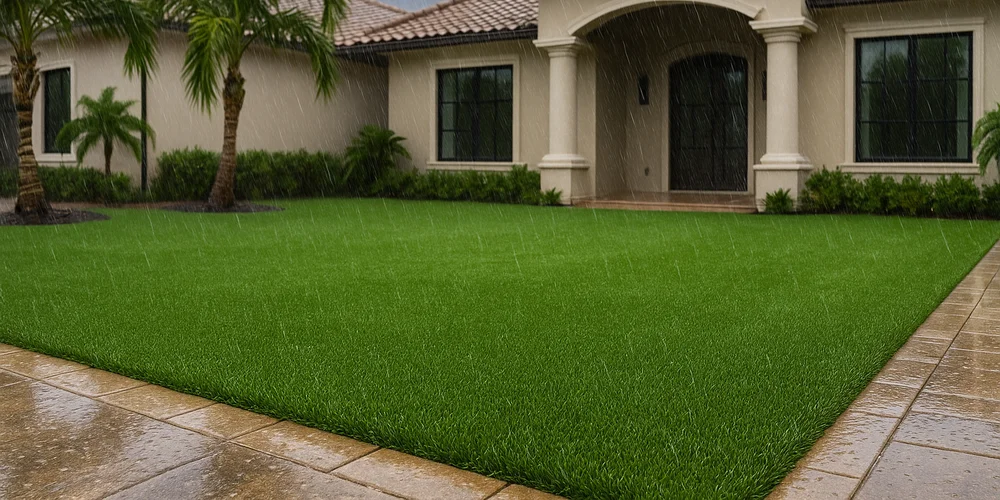
If you live where heavy downpours and strong winds are a fact of life, your lawn strategy has to be different. Storm-Ready Artificial Turf is not a product label—it’s a design approach. It starts with a permeable base that moves water away from the surface, the right infill blend to resist wash-out and keep fibers upright, secure seams and edges that won’t lift, and a maintenance routine that prepares your lawn before a storm and restores performance afterward.
Key takeaways
-
“Storm-ready” is a system, not a single material: base, drainage, infill, seams, edges, and care all work together.
-
Drainage capacity is dominated by the engineered base and sub-drain—not just the turf backing.
-
Heavier, non-floating infills (or blends) resist displacement in wind and sheet flow, while zeolite helps with odor control after long wet spells.
-
A simple pre-storm checklist (de-thatch, top off infill, clear edges) prevents most problems; a post-storm rinse + power-broom restores performance fast.
-
Professional inspection catches hidden issues like seam creep, base settlement, or clogged drains before the next big rain.
What “storm-ready” really means (and why it matters)
A high-performing synthetic lawn can shed water rapidly, resist wind uplift, and bounce back without odors or matting. That requires:
-
Permeable, compacted base – An open-graded base (e.g., ¾″ minus + fines cap or a multi-layer approach) that lets water travel downward and laterally.
-
Sub-drain strategy – French drains or perforated pipe where soils are slow or slopes collect runoff.
-
Secure edges & seams – Mechanical fasteners and construction adhesive/commercial seam tape to stop wind-driven lifting.
-
Infill that stays put – A heavier “ballast” component (coated sand or similar) often blended with performance additives (e.g., zeolite for odors).
-
Maintenance calendar – Light, regular care plus targeted pre-/post-storm tasks.
When you combine those elements, you get a synthetic lawn that drains quickly, keeps its shape, and avoids post-storm problems like ponding, mildew, and persistent smells.
Drainage design: the heart of Storm-Ready Artificial Turf
Think of drainage as a three-layer funnel:
1) Surface & backing
Modern backings are perforated and can move a lot of water, but the bottleneck is usually the base, not the holes. Choose a turf with consistent perforations and a robust primary/secondary backing to maintain dimensional stability during wet/dry cycles.
2) The engineered base
-
Open-graded base layer. Use angular stone compacted in lifts. Depth varies with soil and use, but many residential lawns see success with several inches of compacted aggregate plus a finer leveling course.
-
Slope & micro-grading. Aim for subtle slope (often around 1–2%) toward collection points. Even “flat” lawns should have micro-grades that encourage water migration.
-
Geotextile separation. A non-woven geotextile between native soil and base helps prevent fines from migrating upward and clogging the system.
-
Edge restraints. Concrete curbing, composite bender board, or pavers hold the base profile and help stop edge heave.
For design-build handled by specialists, work with an experienced partner like our Artificial Turf installation company in South Florida to dial in soil-specific drainage and base depths.
3) Sub-drain (where needed)
If you have clayey soils, low spots, or hardscape shedding water onto the lawn, add:
-
French drains alongside or beneath the turf area.
-
Perforated pipe daylighted downslope or tied into a legal discharge.
-
Catch basins near downspouts or hardscape scuppers to intercept sheet flow.
This layered approach prevents surface puddling, protects your base from saturation, and shortens drying time after storms.
Infill choices that stand up to storms
Infill does three jobs: ballast (weight), fiber support, and surface performance (cooling/odor control). In storm-prone regions, choose a blend for balanced performance.
Common storm-ready components
-
Coated silica sand (ballast & stability): Adds weight to resist wind uplift and sheet-flow displacement; coatings reduce dust and moisture absorption.
-
Zeolite (odor & moisture buffering): A porous mineral that traps ammonia—great after long rainy stretches or for pet use.
-
TPE/EPDM elastomeric infills (resilience): Springy feel and fiber support; pair with sand ballast to reduce movement in heavy rain.
-
Organic cork/coconut (cooling): Cooler underfoot but lighter; in storm zones, use as part of a blend, not as your only ballast.
Recommended approach:
Use a layered or blended infill: heavier coated sand for ballast at the bottom, then a performance layer (zeolite or elastomeric) closer to the fiber tips. This combination resists migration while maintaining playability and odor control.
Wind uplift, seams, and edge security
Storm winds find weak points first—seams and edges. A storm-ready build includes:
-
Perimeter anchoring on a set spacing with non-corrosive spikes or screws through the turf’s edge band into compacted base, finished under edging or pavers.
-
Seam system using professional seam tape and urethane adhesive under proper weight and cure time. Avoid “over-sand as glue” approaches.
-
Heavier infill near edges. A modest bump in ballast density within ~12–18″ of edges adds insurance.
-
Hard edging. Pavers or curbs act as wind breaks and help keep the turf plane locked tight.
Seasonal care: a simple maintenance calendar
A little preparation before a storm—and a short reset after—keeps your surface fast-draining and odor-free.
Pre-storm checklist (15–30 minutes for most homes)
-
Clear leaf litter and debris—especially along edges and drains.
-
Top off infill in thin areas; brush fibers upright with a power broom.
-
Confirm flow paths (downspouts, scuppers, and catch basins) are clear.
-
Secure movable items (furniture, toys) that could scuff fibers in high winds.
Post-storm recovery (same day or next clear window)
-
Rinse the surface to remove fines; use a hose, not a pressure washer.
-
Power-broom to stand fibers back up and redistribute infill evenly.
-
Spot treat odors in pet zones; if you prefer pro-care, book professional turf cleaning in South Florida for enzyme treatment and deep rinse.
-
Inspect seams & edges for any lift or creep; early correction prevents bigger repairs.
-
De-compaction pass (as needed): Lightly rake or brush to maintain permeability.
Got pets and want a city-level solution? See targeted services like odor-neutralizing turf cleaning in Boca Raton or storm recovery options such as post-storm turf cleaning in West Palm Beach.
Troubleshooting common drainage issues
Ponding in one corner
Likely cause: micro-grade settled or clogged exit path.
Fix: lift the perimeter, adjust base slope, clear/extend the drain, and re-compact.
Slow drying in shade
Cause: lower evaporation and organic buildup.
Fix: regular brooming and periodic enzyme cleaning; consider trimming overgrowth to allow airflow.
Infill migration after extreme storms
Cause: insufficient ballast or high sheet flow crossing the surface.
Fix: add a heavier ballast layer below the existing infill; consider edging or micro-berms upslope to redirect runoff.
Musty odor after long wet period
Cause: trapped organics and pet residues.
Fix: rinse, then enzyme clean; zeolite top-up can help ongoing control.
For persistent issues or a professional base inspection, contact our team and we’ll assess the sub-drain and base compaction.
Choosing the right installer for a storm-ready build
A storm-resilient lawn is won or lost in the details. Choose installers who:
-
Provide soil-specific base designs and compaction specs.
-
Offer sub-drain options (French drains, perforated pipe, catch basins).
-
Use professional seam systems and hard edging—not shortcuts.
-
Document infill type, amounts, and edge anchoring patterns.
Planning a new project or a corrective re-build? See Turf Installation in Palm Beach for a sense of our standards, scheduling, and design approach. You can also explore our local pages to match your neighborhood’s needs: Broward artificial grass experts, Delray Beach synthetic turf, Boca Raton artificial grass, Jupiter FL artificial turf, Jupiter Island turf pros, and Parkland artificial grass installers.
Cost & ROI of storm-ready upgrades
“Storm-ready” can add modest upfront costs (extra base prep, sub-drain components, stronger edge systems, or blended infill). In return, you get:
-
Lower maintenance after storms (less remediation, fewer repairs).
-
Longer surface life thanks to better stability and drainage.
-
Better daily performance—faster drying, less odor, and consistent footing.
-
Improved curb appeal in the wet season, when natural lawns struggle.
If you already have turf, retrofit options—like adding drains along the downslope edge, re-grading a small section, or switching to a heavier ballast blend—often deliver outsized gains without full replacement.
Homeowner checklist: make your synthetic lawn storm-ready
-
Confirm base depth, compaction, and geotextile are appropriate for your soil.
-
Add sub-drains where your lawn collects runoff or sits over slow soils.
-
Choose a blended infill with ballast + performance components.
-
Anchor edges with hard restraints and use pro-grade seam systems.
-
Build a pre-storm routine: clear debris, top off infill, check drains.
-
After storms: rinse, power-broom, enzyme treat pet zones, inspect seams.
-
Schedule an annual professional inspection before the wet season.
Quick project pathway
-
Design consult – We review soils, slopes, and water paths.
-
Drainage plan – Base spec + sub-drain layout.
-
Material choices – Turf model, infill blend, edge/anchoring details.
-
Build day – Compaction in lifts, seams/edges, infill metering.
-
Handover – Maintenance calendar and storm playbook.
Ready to talk through your site? Reach out here: Get in Touch.
FAQs
1) Does Storm-Ready Artificial Turf drain faster than natural grass?
Often, yes—because a properly engineered base offers predictable permeability and lateral flow, whereas natural soil can seal under foot traffic. The key is the base and sub-drain, not just the turf backing.
2) What’s the best infill for storm zones?
Use a blend: a heavier coated sand layer for ballast plus a performance top layer like zeolite (odor control) or an elastomeric infill for fiber support. Purely light organic infills can shift in sheet flow if used alone.
3) Will high winds lift my turf?
Not if seams and edges are built correctly and infill is adequate. Pro-grade seam tape + adhesive, hard edging, and perimeter anchoring are the main defenses. A slightly heavier infill near the edges adds insurance.
4) How do I prep my turf before a big storm?
Clear debris, check drains, top up thin infill zones, and store items that could scuff fibers. After the storm, rinse, power-broom, enzyme treat any pet areas, and inspect seams/edges.
5) Can an existing lawn be upgraded to be more storm-ready?
Yes. Common retrofits include adding French drains at the downslope edge, re-grading small sections that have settled, and switching to a heavier ballast infill blend. A short site visit can reveal the highest-value fixes.
One-click next step
-
Planning a new build? Start with our Artificial Turf installation company in South Florida overview.
-
Curious about our standards? Browse Turf Installation in Palm Beach for a sample scope.
-
Prefer to talk it through? Contact our team now.